AI mission control01
MissionOS connects AI judgment, human approval, constrained execution, and outcome verification across drones, robots, and a Starship-inspired simulator. A design and development report grounded in saved simulation cases.
AI mission control02
MissionOSの管制レイヤーを、横浜でのVLA・WAM配送、移動ロボット、操作修復、Starshipの再計画・診断から整理する。共通の権限・証拠管理と、成功・停止・未検証を分けた試験記録。
Space systems03
The full development story: a continuous flight simulator, AI mission decisions, fault diagnosis, physical-model audits, and the separately registered October 23 integrated mission.
Robotics & AI04
MissionOS separates model judgment, human authorization, constrained execution, and outcome verification, with explicit evidence for each transition.
 ▶ Video & figures
Robotics & AI05
Predictive stopping improved simulated stacking scores over weak baselines, while strong simple rules and known-case integration runs define the limits of the claim.
Robotics & AI06
Controlled LIBERO experiments separate corrective targeting from stable repair, preserving negative results and the limits of comparisons among GR00T, Cosmos Policy, and VLA-0.
 ▶ Video & figures
Robotics & AI07
Two recorded Go2 simulator runs connect approval, navigation, simulated receipt, and return while showing exactly when DeepSeek was—and was not—invoked.
 ▶ Video & figures
Autonomous missions08
Native VLA and world-model proposals completed a bounded simulated delivery, while separate wind and gust experiments exposed unresolved recovery limits.
 ▶ Video & figures
Autonomous missions09
Landing-pad studies separate verified waiting and permission renewal from unqualified native forecasts and modest, correlated replay-only decision changes.
Autonomous missions10
Ship-to-shore experiments distinguish route-selection value, camera-based execution, and native-model integration while preserving failed implementation cohorts.
 ▶ Video & figures
Space systems11
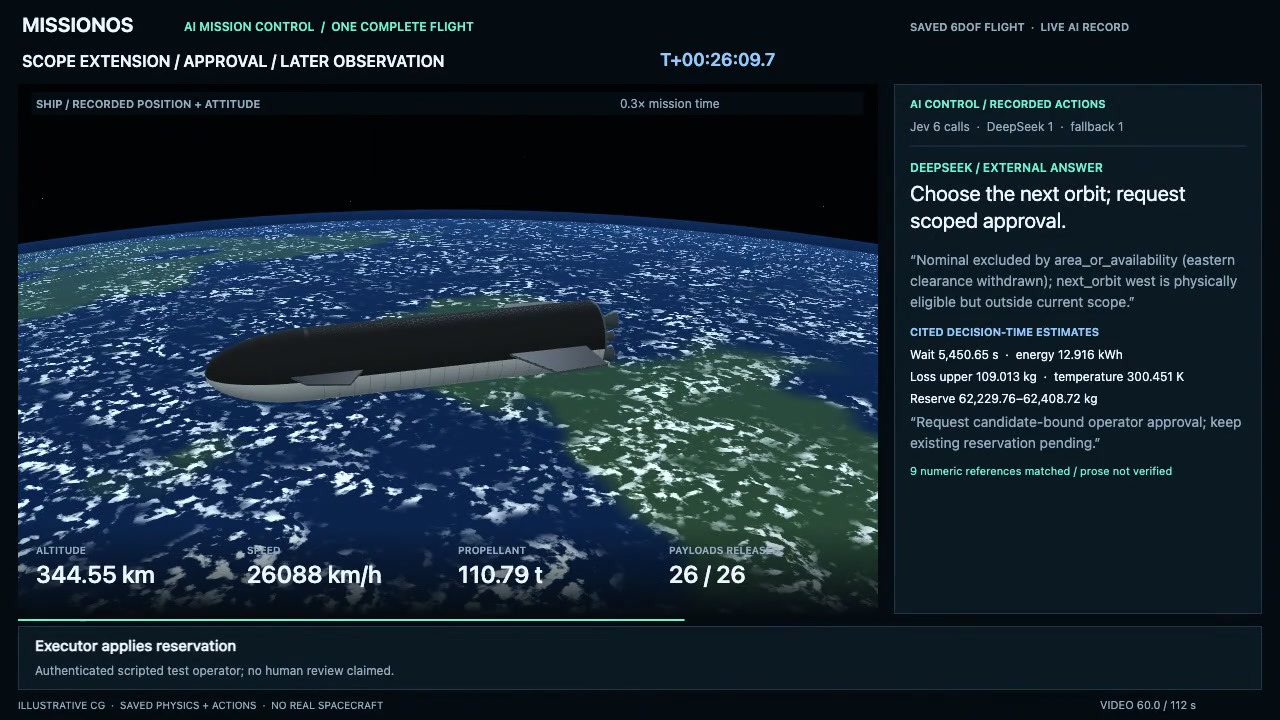
A development simulator connects approved mission scope to live return replanning while distinguishing record integrity, modeled contact, and real vehicle capability.
Computational biology12
Across 105,000 simulated observation sequences, acquisition cadence and molecule count support different levels of mechanism discrimination and mixture estimation.
Computational biology13
A genome-scale investigation corrected an intuitive explanation, tested finite reusable resources, and reached the limits of public-data validation—without establishing a new biological mechanism.
Computational biology14
Factorial simulations separate recycling from binding and loading, while public initiation-rate tables and a clock-scaling control show why curve shape alone cannot validate a human replication mechanism.
No matching articles. Try another keyword or select All research.
